Understanding how many bids you can place in an IPO and the associated rules is critical for maximizing your chances while avoiding invalid or rejected applications. Before deciding your strategy, it helps to revisit the basics of an IPO bid and how bidding works.
This article explains the bid limits, price range constraints, and important guidelines issued by SEBI and stock exchanges for Indian investors.
Before placing multiple bids, investors should first look at the live and upcoming IPOs to decide which issues fit their risk and return expectations.
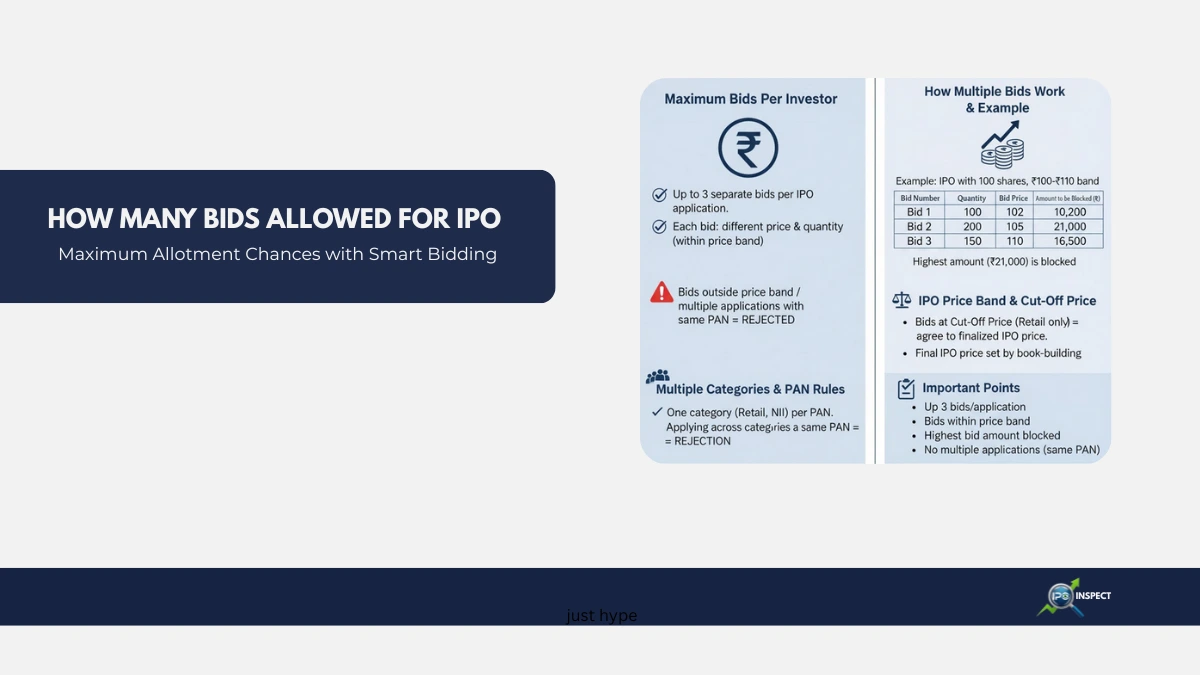
Maximum Number of Bids Per Investor
- Investors typically allowed up to 3 separate bids per IPO application.
- Each bid can have a different price and quantity, but all must within the IPO price band announced by the company.
- Bids outside the price band or multiple applications with the same PAN are subject to rejection.
These bid limits fit into the broader IPO cycle and application stages, from bidding to final listing.
How Multiple Bids Work Practically
- You can place bids at different prices between the floor and cap price to improve allotment chances.
- Only the highest amount is blocked in your bank account among the bids during the IPO period through the ASBA IPO application process.
Example:
For an IPO with a lot size of 100 shares and price band ₹100 to ₹110:
| Bid Number | Quantity | Bid Price | Amount to be Blocked |
|---|---|---|---|
| Bid 1 | 100 | ₹102 | ₹10,200 |
| Bid 2 | 200 | ₹105 | ₹21,000 |
| Bid 3 | 150 | ₹110 | ₹16,500 |
Here, the highest blocked amount will be ₹21,000 for the second bid, although all bids are valid.
When planning bid quantities across different price points, it is equally important to know how many lots you can apply for in an IPO, since lot size directly controls your total application value.
IPO Price Band and Cut-Off Price
- The final IPO price is decided by book building or fixed price issue mechanics after the bidding closes.
- Bidders opting to bid at the cut-off price in an IPO agree to pay the finalized issue price even if it is lower than their bid.
- SEBI allows bidding at cut-off price in the retail category, improving simplicity.
Multiple Categories and PAN Rules
- Investors can bid only in one category (Retail, NII, QIB) using the same PAN to avoid multiple application rejection.
- Separate categories like Employee or Shareholder may allow additional bids without penalty.
- Applying across multiple categories with the same PAN (Retail + NII) leads to rejection.
Important Points to Remember
- Up to 3 bids with different prices/quantities allowed per application.
- Bids must be within the price band.
- Highest bid amount blocked from your account for the listing process.
- Multiple applications with the same PAN lead to cancellation and are among the key IPO allotment rejection reasons investors should avoid.
- Pay attention to category-specific rules and overall regulations by SEBI.
Conclusion: Placing multiple bids within prescribed limits can optimize your IPO application success. Following SEBI guidelines on bid numbers, price ranges, and category restrictions protects you from application rejection and helps navigate the IPO allotment process effectively.