Face value, also known as par value or nominal value, is the fixed price assigned to each share by a company when it issues shares through an IPO.
This value is printed on the share certificate and represents the base or original cost of a share on the company’s books.
Understanding face value helps investors grasp key financial concepts related to IPO pricing and share capital.
What is Face Value in IPO?
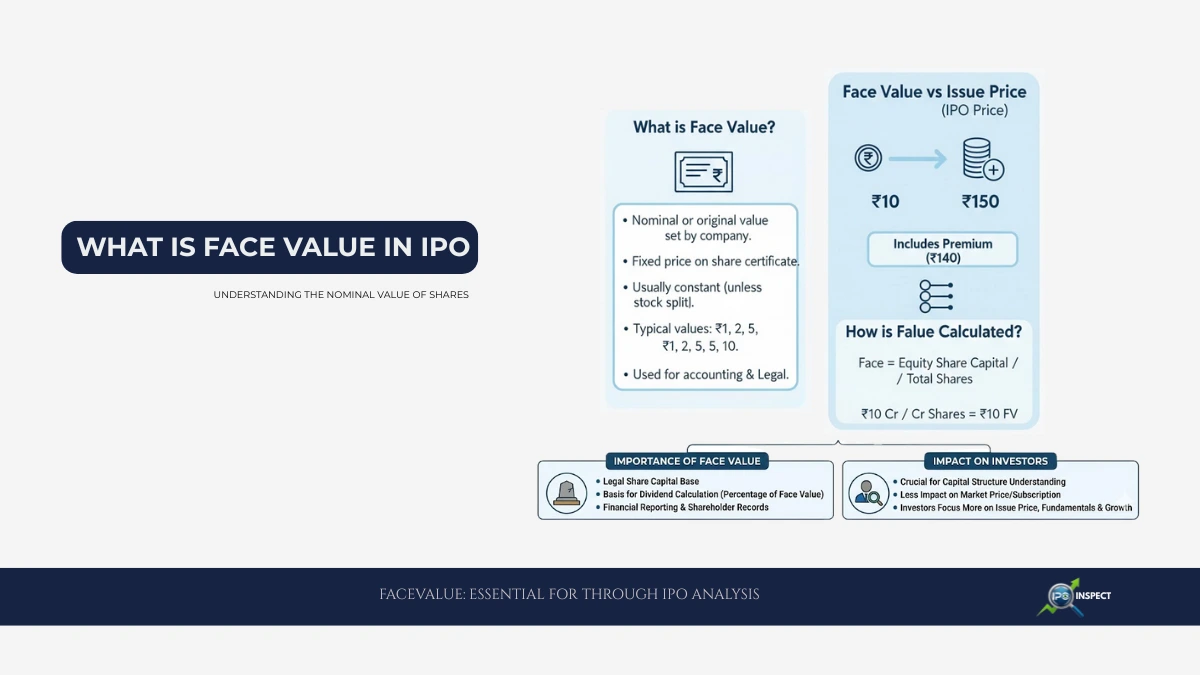
- Face value is the nominal or original value of a share set by the company during issuance.
- It usually remains constant unless the company does a stock split or consolidation.
- Typical face values in India include ₹1, ₹2, ₹5, ₹10, or sometimes higher based on company policy.
Difference Between Face Value and Issue Price
- Face Value: Base value per share, used in accounting and legal documents.
- Issue Price (IPO Price): The price at which shares are sold to investors during the IPO, which includes a premium over the face value reflecting market demand, company valuation, and how IPO listing price is decided.
For example, a face value of ₹10 with an issue price of ₹150 means the company sells shares at ₹150 where ₹140 is premium. Various factors influencing listing gains can further impact the difference between issue price and market performance following an IPO.
How is Face Value Calculated?
Face Value = Equity Share Capital / Total Number of Shares Issued
For instance: If a company has equity capital of ₹10 crore and 1 crore shares, face value per share is ₹10.
Importance of Face Value
- Determines the share capital of the company legally.
- Basis for calculating dividends; dividend rates are often expressed as a percentage of face value.
- Useful in financial reporting and shareholder records.
Face Value and Its Impact on Investors
- Face value rarely changes the market price or IPO subscription decision.
- Investors focus more on issue price, company fundamentals, and growth prospects.
- But understanding face value is essential for grasping capital structure and dividend calculations.
- While the face value is rarely a deciding factor for market price or IPO subscription, understanding valuation through analyzing IPO fundamentals helps investors make informed decisions.
Conclusion: Face value is the nominal, fixed cost of a share set by the issuing company during IPO and is vital for legal and accounting purposes. It differs from the issue price, which reflects market valuation and includes premium over face value. Investors should understand both concepts for thorough IPO analysis.
For investors participating in IPOs, it’s equally important to understand the ASBA application process for secure investment and refund handling. To apply these concepts, browse the current and upcoming IPO opportunities available in India.