Book building is a popular IPO pricing mechanism where investors specify their preferred price within a given price band, similar to how the overall IPO price discovery process works in the primary market.
Two important concepts in this process are the bid price and the cut off price, which often confuse new investors.
Understanding their difference helps you make informed decisions and optimize your chances of IPO allotment when combined with a clear view of how shares allotted in IPOs.
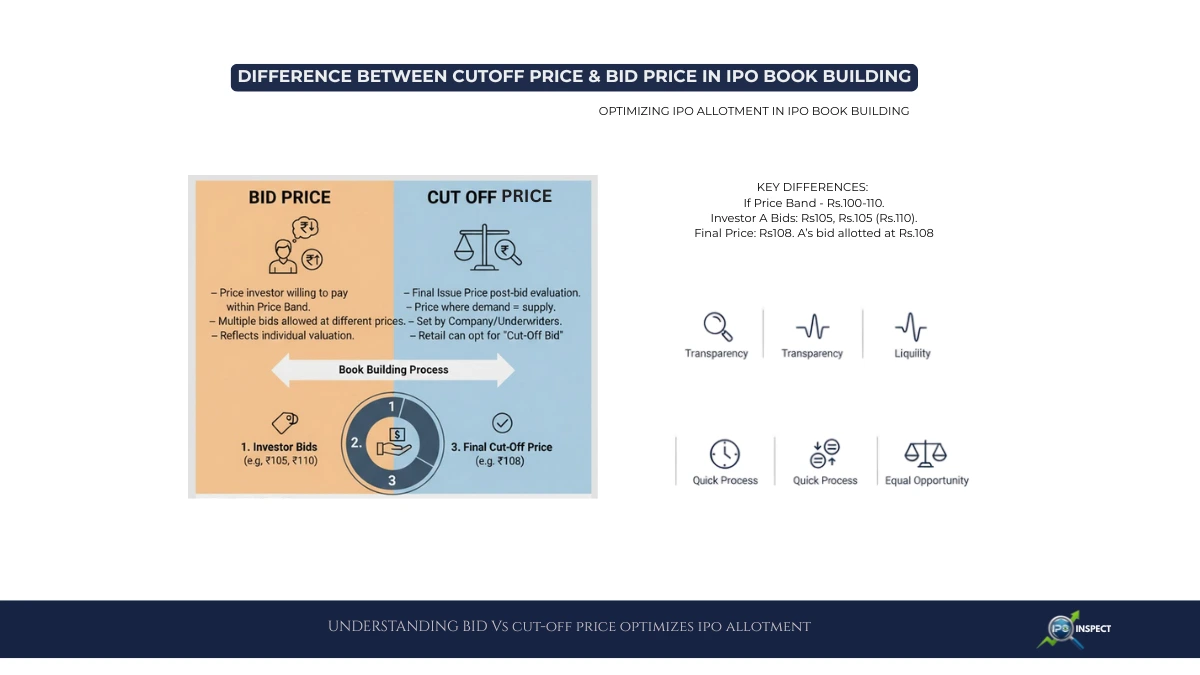
What is Bid Price in Book Building IPO?
- The bid price is the actual price at which an investor is willing to subscribe to the IPO shares, submitted within the DIP (Price Band).
- Investors can place multiple bids at different prices within the band to improve their probability of allotment.
- The bid price reflects an individual’s price valuation of the company based on market sentiment, often guided by grey market premium trends and personal research..
What is Cut Off Price in Book Building IPO?
- The cut off price is, final price determines with post bid evaluation, where total demand equals or exceeds the shares offered.
- This may set by the company and lead managers (underwriters) based on aggregated bids.
- Retail investors often bid at the cut off price to simplify their application, agreeing to pay whichever price finalized.
For many retail investors, choosing the cut-off option goes hand in hand with using ASBA for IPO applications, since funds only blocked at the final issue price.
Key Differences between Cut Off Price & Bid Price
| Aspect | Bid Price | Cut Off Price |
|---|---|---|
| Definition | Price investor bids for shares within band | Final issue price fixed after bid evaluation |
| Purpose | Indicates individual investor’s willing price | Price that clears the market demand |
| Number Allowed | Multiple bids with varying prices allowed | Only one cut off price set after bidding |
| Role | Helps company assess demand at different prices | Actual price investors pay if bidding at cut off |
| Retail Bids | Can bid anywhere within band | Retail can opt to bid only at cut off |
How Cut Off Price and Bid Price Work Together in Allotment
- The company uses all bids to determine the cut off price optimizing for maximum subscription and proceeds as part of the broader IPO cycle and book building stages.
- Investors bidding above or at cut off allotted shares pro-rata if oversubscription exists, according to the rules on how IPO allotment calculated when oversubscribed.
- Investors requesting prices below cut off may receive no shares, and frequent non-allotment may better understood by reviewing why some investors don’t get IPO allotment.
Why Should Investors Care about Cut Off Price and Bid Price?
- Bidding at cut off simplifies application and maximizes allotment chances for retail investors.
- Placing multiple bids at varying prices allows more flexibility but requires careful fund management.
- Knowing the difference prevents confusion during IPO finalization and reduces application errors such as IPO allotment rejections or UPI mandate issues explained in the UPI errors IPO fix guide.
Example:
If the price band is ₹100 to ₹110:
- Investor A bids 100 shares at ₹105, another 50 at ₹108.
- Investor B bids 200 shares at cut off price ₹110.
If the total demand at and above ₹108 clears the offering size, the cut off price is ₹108 or ₹110. Investor A’s higher bid may allotted at cut off price, while bids below cut off may not.
Conclusion: The bid price is your personal offer price within the IPO price band, while the cut off price is final IPO issue price decided by aggregating all bids. Both play crucial roles in the IPO allotment process, and understanding their difference along with concepts like IPO bids and face value in IPO empowers smarter investing decisions in upcoming IPOs.